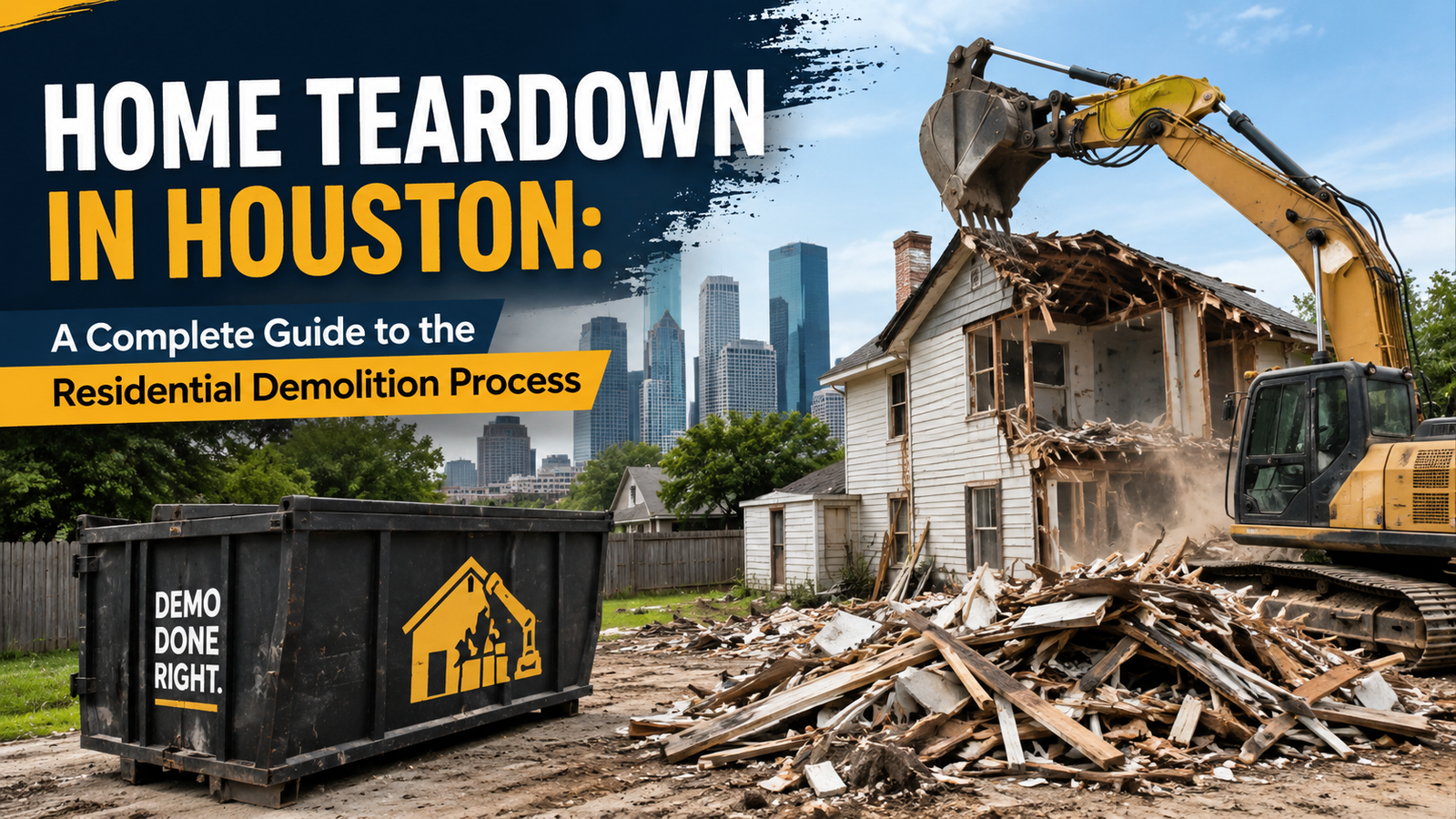

Residential home teardowns are among the most visible and frequent demolition activities across Houston and its surrounding communities. In established inner-loop neighborhoods where land values have risen substantially, teardown-and-rebuild has become a dominant pattern. In flood-impacted areas, homes damaged beyond economical repair are torn down. Across the city’s ongoing efforts to address blighted properties, residential demolitions transform problem properties into developable assets. This guide explains what a Home Teardown Houston involves from start to finish.
Why Homes Are Torn Down in Houston
Houston’s home teardown market is driven by several distinct forces. Redevelopment in desirable neighborhoods is perhaps the most visible driver. Communities like West University Place, Bellaire, Meyerland, River Oaks, Memorial, and the Heights have seen sustained teardown activity as buyers acquire older homes for lot value and then build new structures that better meet modern expectations. Houston’s lack of citywide zoning creates a permissive environment for this type of infill redevelopment.
Flood damage is another significant driver specific to Houston. The Greater Houston area has experienced repeated major flood events including Hurricane Harvey in 2017, which caused unprecedented flooding across the region. Homes that sustained repeated or severe flood damage may be economically infeasible to repair, particularly when the combination of structural damage, mold remediation requirements, and the risk of future flooding makes rebuilding on an elevated foundation a more rational choice than renovation.
Structural deterioration beyond economical repair, fire damage, and the age of older Houston-area housing stock also drive teardowns. Houston has a significant inventory of post-war housing modest ranch homes and bungalows built in the 1940s through 1970s that has reached the point where the cost of comprehensive renovation approaches or exceeds the cost of teardown and new construction.
Houston’s Home Teardown Permit Process
Home teardowns in Houston require a residential demolition permit from the City of Houston’s Department of Neighborhoods. For structures built before 1980, TCEQ requires an asbestos inspection before demolition proceeds. Many Houston-area homes also exist within deed-restricted communities or homeowners associations that have their own requirements for demolition activity, including protecting adjacent properties, managing debris, and restoring the site upon completion.
Utility disconnections are coordinated with CenterPoint Energy, the relevant water utility, and telecommunications providers before physical demolition begins. For homes served by individual septic systems more common in unincorporated Harris County and surrounding counties the septic system must also be properly decommissioned in accordance with TCEQ regulations before demolition of the structure begins.
The Physical Demolition of a Houston Home
Houston’s typical residential housing stock concrete slab foundation, wood-frame or masonry walls, composition shingle roofing responds well to mechanical demolition with a mini-excavator or mid-size excavator. Operators systematically dismantle the structure from the roof downward, breaking framing and walls into sections that are loaded into dump trucks for hauling.
Houston’s heat creates logistics considerations for residential teardowns. Summer temperatures regularly exceed 100°F, and contractors schedule work to account for crew safety. Concrete slab breaking is often scheduled for early morning hours during peak summer months. Slab removal follows the above-grade demolition the concrete slab is broken with a hydraulic breaker attachment and removed. In Houston, where slab foundations are prevalent and expansive clay subsoil creates differential movement, proper removal of the existing slab and preparation of the subgrade is particularly important for the performance of any new foundation poured in its place.
Elevation and Flood Considerations
For homeowners in Houston flood-prone areas including Meyerland, Westbury, and Braeswood communities along Brays Bayou, and numerous other neighborhoods within FEMA-designated Special Flood Hazard Areas home teardown is sometimes the first step in rebuilding at a higher elevation. FEMA’s National Flood Insurance Program and Harris County Flood Control District both offer programs that incentivize or require elevation of flood-damaged structures above the Base Flood Elevation.
Common Questions About Home Teardowns in Houston
Does the city of Houston require a permit for a home teardown? Yes. A residential demolition permit is required from the Department of Neighborhoods. Contractors must be properly licensed and insured, and the permit process includes required inspections and utility disconnection confirmation.
How long does a typical Houston home teardown take? The physical demolition of a typical Houston single-family home including slab removal and debris hauling generally takes one to three days. The overall project timeline including permitting, asbestos inspection and abatement if required, and utility disconnection coordination typically spans several weeks.
What should the site look like after the teardown? A professionally completed Houston home teardown leaves a graded, debris-free lot with positive drainage, no above-grade debris, and appropriate erosion control in place.